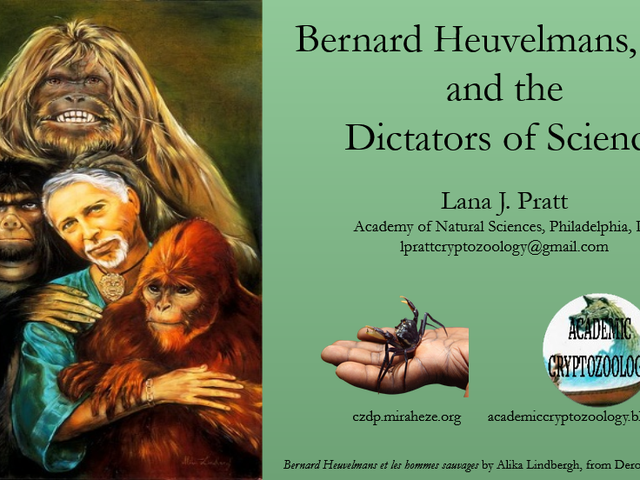
Bernard Heuvelmans, the "Father of Cryptozoology", is frequently portrayed as either a genius and prophet or an incompetent fool; in large part because the focus is always on the facticity of his claims rather than their cultural context. As a result Heuvelmans exists as little more than a caricature of himself in the contemporary cryptozoological literature. But who was he really?
It's a distinct pleasure to be asked to a review a book like Jamie Lewis and Andrew Bartlett's BIGFOOTERS AND SCIENTIFIC INQUIRY. Not only because it's a profound work of scholarship but also one that will forever alter the conversation around academic research in cryptozoology.
I'm currently working with Nicholas Driscoll (MA, Applied Linguistics, ISU) on a proposal for an English translation of Shigeru Kayama's cryptid novella Half-Human, which you can learn about by watching this YouTube video.
My review of historian of science Brian Regal's new book DARWIN AND THE MONSTERS which demonstrates the difficulties of writing a history of a discipline like cryptozoology with no fixed definition...
How my quest last summer to get ahold of a copy of the earliest Japanese adaptation of a Lovecraft story eventually led to its first ever English translation, now available online for free!
In March of 2026 I was on a round-table panel titled "Pelts or Portals: Cryptid Identity in the 21st Century" at the second Gods & Monsters conference at Texas State University, hosted by religious studies scholars Joe Laycock and Natasha Mikles.
"Cryptozoologists triumph when they can substitute Neanderthals, giant apes and long necked seals for devils, trolls and dragons. But it is a short-lived victory. They are still asking us to believe, just as the storytellers of old did."
— Michel Meurger, “Interpreting Myth,” Fortean Times no. 54 (Summer 1990): 49.